Built for professional realisation
Insolvency practitioners
Account for the realisation to creditors and supervisory authorities.
Companies in reorganisation
Show that the assets were offered in open competition.
Liquidators
The final account is reviewed by the auditor.
Estate administrators
Give the beneficiaries something more than a receipt.
Municipalities and regions
A disposal that withstands judicial review.
Government agencies
Sound commercial practice is a procedure, not a price.
Insurance companies
The residual value should not come down to one party's word against another's.
Audit and accounting firms
Leave your client's disposal to us — you keep the advisory relationship.
What matters is being able to show how the assets were sold.
The question rarely comes when the deal is done. It comes months later, from a creditor, a reviewer or a supervisory officer — and then the procedure must be reconstructed from listings that have been taken down, emails across separate threads and bid records held by three different platforms.
Budgiv reverses the order. The record is built while the sale is under way.
How it works
- You send the inventory list. Or a brief description of what is to be disposed of.
- We divide it into sale lots — each with its own reserve price — and choose channels for each lot.
- Publication on all selected channels, over the same period.
- Bids are collected and time-stamped, channel by channel.
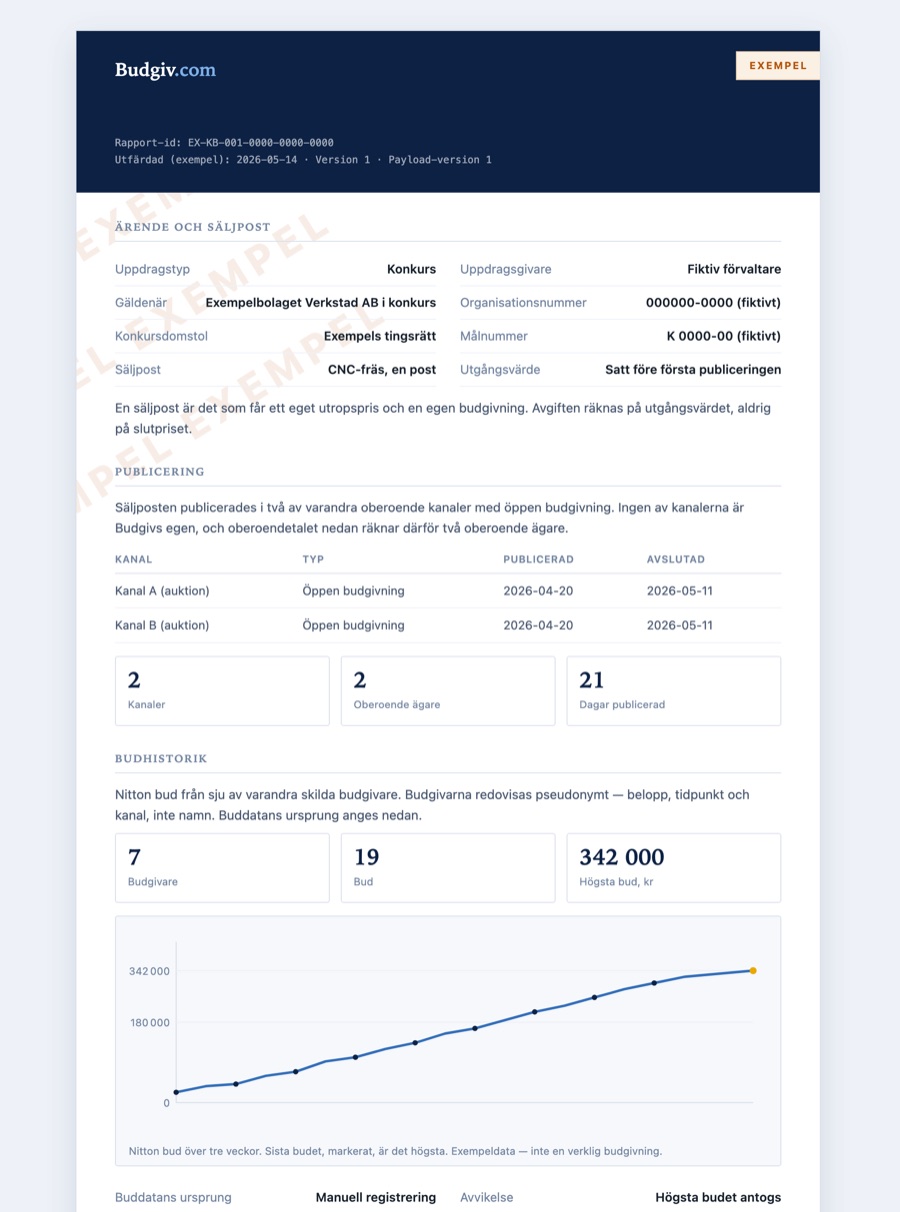
- You decide. The record is issued — a signed, hash-linked and qualified time-stamped Realisation Report that anyone can verify, without an account and without contacting us.
The two outcomes
What you pay for is that the assets are tested against the market — and that the test can be documented, whatever the result.
- If the sale lot sells — the report shows what the market paid: where it was offered, over what period, on which channels and what outcome it received.
- If it does not sell — the report shows that several independent channels displayed the sale lot during the stated period without a single bid coming in. That documentation is often harder to obtain after the fact than a receipt for a sale that did take place.
Both paths end with you being able to account for what happened with each lot.
When the question comes, the answer is already there
- Were the assets available to the market?
- Which channels were used, and for how long?
- What response came in? Which bids were recorded?
- How was the process concluded?
Questions that otherwise cost an afternoon to answer — and that sometimes cannot be answered at all.
We do not compete with the marketplaces. We use them.
Auction sites and listing platforms do their job well: they let the market set the price. But each of them sees only its own part of the process — its bids, its listing period, its history. None of them can show what happened on the others.
Budgiv sits above them. A sale lot is published across several channels, and the combined process — where, for how long, which bids, what outcome — becomes a single document.
The marketplace provides the price. Budgiv provides the evidence of how the price came about.
Work it out for yourself: how many independent counterparties do your channels amount to? →
What you receive
The evidence is a document that answers the question before it is asked.
- The sale lot — what was offered to the market
- The timeline — when it was published, how long it ran, when it closed
- The channels — where it was exposed, and for how long on each
- The bids — what came in, when, and on which channel
- The outcome — how the process was concluded
- The verification — signed, hash-linked and qualified time-stamped
Every entry carries its provenance: whether it was observed by us or obtained from a channel.
The point in time is not merely our word. The head of the chain is time-stamped by InfoCert, a qualified trust service provider in the EU. The stamp can be verified against the EU trusted list — by anyone, without an account and without contacting us.
Frequently asked questions
Does Budgiv sell the assets?
Does Budgiv decide who is allowed to buy?
Is the report a valuation opinion?
Can the recipient verify the report without having to trust you?
What does "qualified time stamp" mean?
Insight
All guidesTake the entire disposal off your desk.
One agreement with us — and a record that holds up when the deal is reviewed. Describe the engagement, and we will come back with a proposed choice of channels and a price. No account required.
Describe the engagement